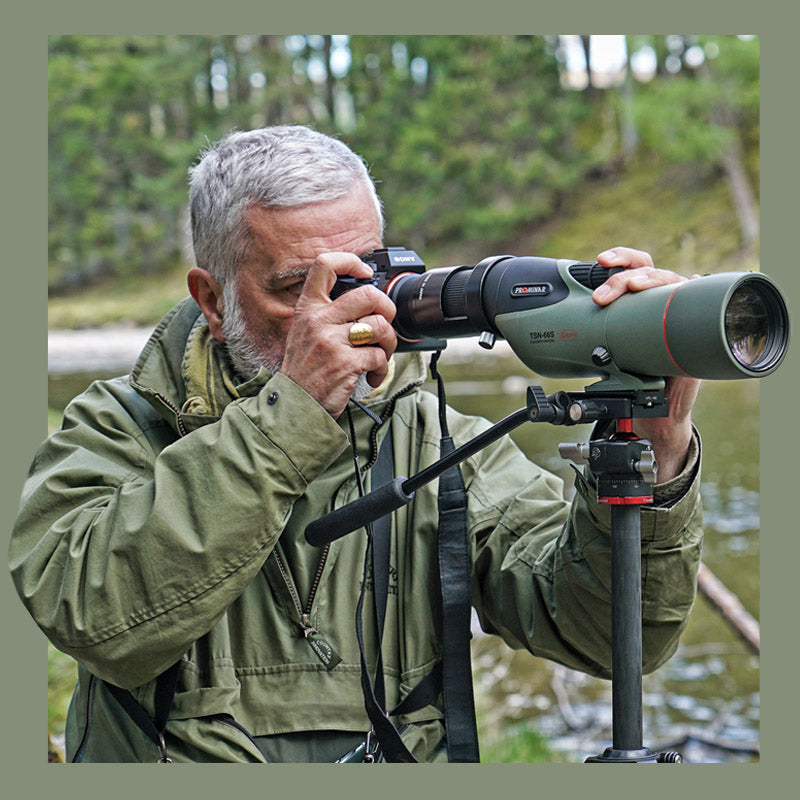

Digiscoping (pairing a camera or smartphone with a spotting scope) is one of the best ways to capture dramatic close-up images of wildlife and birds. But not every spotting scope is designed for this unique blend of observation and photography. The right scope can make the difference between a blurry snapshot and a truly stunning image.

So what separates an average digiscoping setup from an exceptional one?
Light Transmission and Faster Shutter Speeds

One of the biggest challenges in digiscoping is controlling shutter speed. At high magnifications, even the smallest movement from wind, vibration, or a shifting subject can soften your photo.
A larger objective lens gathers more light, allowing your camera or smartphone to use faster shutter speeds. Faster speeds help freeze motion, reduce blur, and deliver sharper detail, especially in low-light conditions like early morning or late evening.
That’s why scopes with large objective lenses (around 80–99 mm) are often favored for digiscoping. They produce bright, high-contrast views that translate directly into cleaner images.
That said, today’s premium compact scopes (55–66 mm) can also perform beautifully. With modern coatings and high-end glass or fluorite crystal, they offer an excellent balance of portability and image quality, ideal for travel or long hikes.
Optical Performance: ED Glass and Fluorite Crystal

Digiscoping magnifies everything, including optical flaws. Any color fringing or chromatic aberration becomes more noticeable once a camera sensor is involved.
This is where ED (extra-low dispersion) glass plays a major role, helping maintain crisp edges and accurate color. The quality of ED glass varies greatly and can be found/claimed to be in optics from $50 to $5,000.00. You will also see this listed not only as ED, but also HD, XD, etc.
For the highest level of performance, fluorite crystal optics are considered the gold standard. Fluorite virtually eliminates chromatic aberration while delivering outstanding contrast and natural color, critical when capturing fine feather detail or high-resolution wildlife images.
Focusing Precision and Shallow Depth of Field

At the magnifications used in digiscoping, depth of field becomes extremely narrow. Only a small slice of your subject will be perfectly sharp, so focusing accuracy is essential.
A dual-speed focusing system makes this much easier. Coarse focus helps you find the subject quickly, while fine focus lets you dial in razor-sharp detail. Even tiny adjustments can make a visible difference in image clarity.
Eyepiece Design: Wide-Angle Views and Zoom Versatility

The eyepiece is just as important as the objective lens.
A wide-angle eyepiece helps prevent vignetting (dark corners in your photo), especially when using smartphone adapters. It also ensures full-frame, edge-to-edge coverage.
Zoom eyepieces add flexibility by letting you adjust magnification for composition and subject distance. The best zoom designs maintain brightness and sharpness throughout the entire range, giving you creative control without sacrificing image quality.
Digiscoping Compatibility and Adapter Systems

A great scope isn’t just about optics, it also needs to work seamlessly with your camera setup.
The best digiscoping scopes support dedicated adapters that are secure, easy to attach, and precisely aligned. Whether you’re using a DSLR, mirrorless camera, or smartphone, a stable connection is essential for sharp, distortion-free results.
An integrated adapter system also makes it much faster to switch between observation and photography in the field.
Why Kowa PROMINAR Scopes Excel for Digiscoping

Kowa PROMINAR spotting scopes are built with digiscopers in mind, offering the features that matter most:
-
Fluorite Crystal Optics for exceptionally pure color, minimal chromatic aberration, and ultra-sharp, high-contrast images, even at extreme magnifications.
-
Dual-Speed Precision Focusing, with smooth coarse and fine controls that make pinpoint sharpness easy despite shallow depth of field.
-
Wide-Angle ED Zoom Eyepieces, engineered to reduce vignetting and deliver bright, edge-to-edge clarity with advanced lens elements and field flatteners.
-
Kowa System Adapters, providing fast, secure connections for both cameras and smartphones while maintaining perfect optical alignment.
-
Lightweight Magnesium Alloy Construction, offering durability and portability without compromise in the field.
A Scope That Brings Distant Detail to Life
Kowa PROMINAR scopes check every box for serious digiscopers; world-class optics, precise focusing, outstanding versatility, and effortless adaptability.
Whether you’re capturing the iridescent plumage of a kingfisher or even the textured craters of the moon, PROMINAR scopes transform distant beauty into vivid, detailed reality.